
2025_01 Salztolerante Sorghum-Hirse
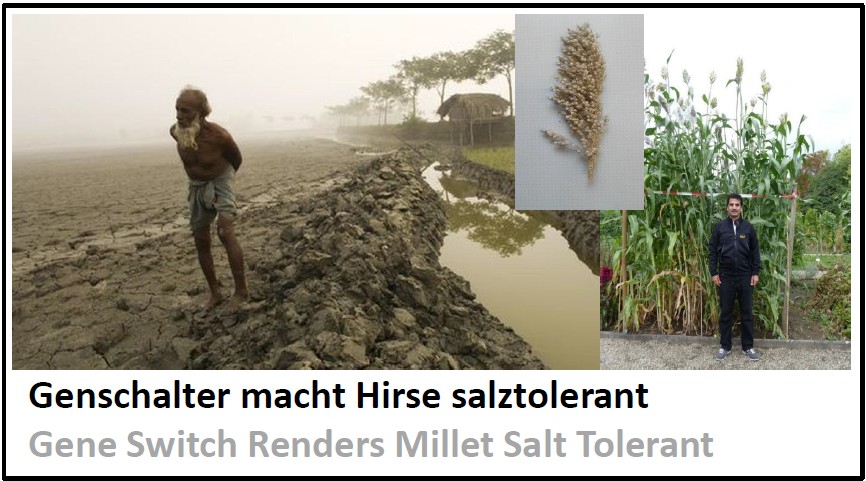 |
Climate changes makes sea levels rise making fertile coastal land salty. The Nile delta, Bangladesh, Vietnam, but also the South of Italy are already today confronted with salt stress. Can we find crop plants that are able to thrive on such soils? In the past, we have, initiated by our Syrian colleague Dr. Adnan Kanbar, focused on stress resilience in Sorghum Millet. This ancient crop originates from Sudan and can cope with harsh conditions. In fact, we were able to show that some Sorghum varieties not only can grow under salinity, but accumulate more sugar when confronted with salinity. What happens to this sugar, differs - some Sorghum varieties store it in the shoot, what is interesting for bio-economic use (for instance for the production of bio-ethanol) others store it in their seeds, what supports food security in regions affected by soil salinity. During her PhD our colleague Eman Abuslima from Egypt was able to uncover the reason for the different sugar use: a gene switch for the sugar transporter SWEET13 decides. A very active version of this switch could be identified in the old Syrian landrace Razinieh. By breeding, this switch can now be crossed into other millet varieties, and by means of the molecular knowledge, the promising individuals in the progeny can be recognised already in the seedling stage by a simple PCR. Publication 216. Abuslima E, Kanbar A, Ismail A, Raorane ML, Eiche E, El-Sharkawy I, Junker BH, Riemann M, Nick P (2025) Salt stress-induced remodeling of sugar transport: a role for promoter alleles of SWEET13. Nature Sci Rep 15, 7580 - pdf Media echo vbio - idw online - openpress - DBG - pugnalom - Ruhrcampus online
|
|