
Alumni
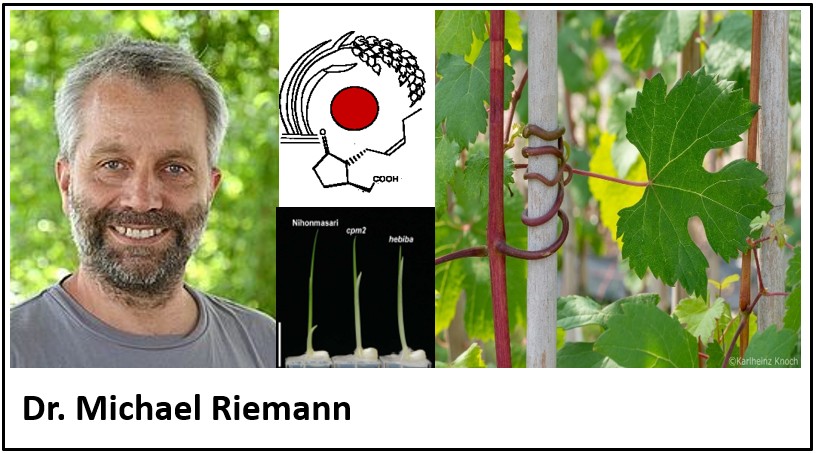 |
Dr. Michael RiemannIn the lab: from 1998-2024 Currently: Head of the lab for Viticulture and Enology at the Federal Institute for Biological Agriculture (FibL) in Frick, Switzerland. more... Activities in our lab: Michael joined the lab already in Freiburg as a student HiWi. Already his diploma thesis was on Grapevine - more exactly on its pathogen, Plasmopara viticola. In cooperation with Hanns-Heinz Kassemeyer from the State Institute for Viticulture, he analysed the cytoskeleton of this oomycete during infection. Already during his PhD he moved into his later subject, jasmonates in rice. Working on the hebiba mutant that mixes up light and dark, he discovered that this mutant is not able to accumulate jasmonates. After completing his PhD in 2004, he left the lab for Japan to identify the gene mutated in hebiba by genetic mapping. During his time in Tsukuba, funded by a Japanese fellowship, he succeeded to find the cause for the mutation, a deletion removing the gene Allene Oxid Synthase, required for the synthesis of jasmonic acid. In 2006, he returned to our lab, now in Karlsruhe and built up the Plant Stress Group, where he explored the role of jasmonates for stress signalling and resilience in rice and also mentored numerous visiting scholars and PhD students, as well as undergraduate theses. He became an internationally renowned expert on jasmonate biology and was also very active in teaching, offering own modules and introducing crowds of students to science. In parallel to his rice research, he always participated in our research activities on grapevine and during several Interreg projects, he was our main contact person for our cooperation partners. That is why FibL became interested and offered him a group leader position, which he accepted in 2024, because it is a great opportunity to move concepts on plant stress into real-world application. |
 |
Dr. Vaidurya Pratap SahiIn the lab: from 2016-2021 Currently: Head of the Departmen of Genetics and Plant Breeding, Sam Higginbottom University of Agriculture, Technology and Sciences (SHUATS), Allahabad, Uttar Pradesh, India. more... Activities in our lab: Vaidurya was first an active member of our Cellular Biotechnology group. Here, he was working on an unconventional class XIV kinesin, investigating the cellular functions of this protein by superresolution microscopy. Later, he joined the Applied Biodiversity group, where he was working on traditional Ayurvedic plants that are hyped in the West as superfood. Topics were Moringa, Tulsi, but also Cinnamom. In parallel, he participated in our project Vitifutur, where he was contributing by work on the anatomy of grapevines infected by Grapevine Trunk Disease, a problem that is emerging in consequence of global climate change. In addition, he was very active in teaching, both in the Bachelor (Crop Plant Practical, Cell Biology for Chemical Biology) as well as in the Master (Plant Cell Biology, Plant Evolution), and also supervising a bunch of Bachelor and Master students. |
 |
Dr. Islam KhattabIn the lab: from 2017-2021, back in the lab since 2025 Currently: Postdoc in the group of Prof. Dr. Anne Kaster, Institute for Biological Interfaces 5, KIT North Campus. more... Activities in our lab: Islam was joining as PhD student, funded by a scholarship from the German Academic Exchange Service (DAAD) in frame of the German-Egyptian Research Longterm Scholarship. He was working on Grapevine Trunk Diseases, a new type of pest, emerging in consequence of climate change. He was member of the Plant Stress group and established a standardised infection system, which allowed him to follow the defence responses by a combination of physiology, microscopy, gene expression, and chemical analytics. He could demonstrate that Vitis sylvestris, the ancestor of domesticated grapevine harbours resistance factors against this disease, and that this is brought about by alterations of chemical communication between fungus and plants. Later, he was able to identify several of the signals, for instance a surrender signal that tells the fungus that its host is under severe stress, inducing a host change. After a short interlude in his home university, Damanhour, in Egypt, he returned to the KIT and currently works as postdoc in the group of Prof. Dr. Anne Kaster at the IBG 5 on the role of the root microbiome in health and disease, as member of the project Microbes for Future (M4F). |
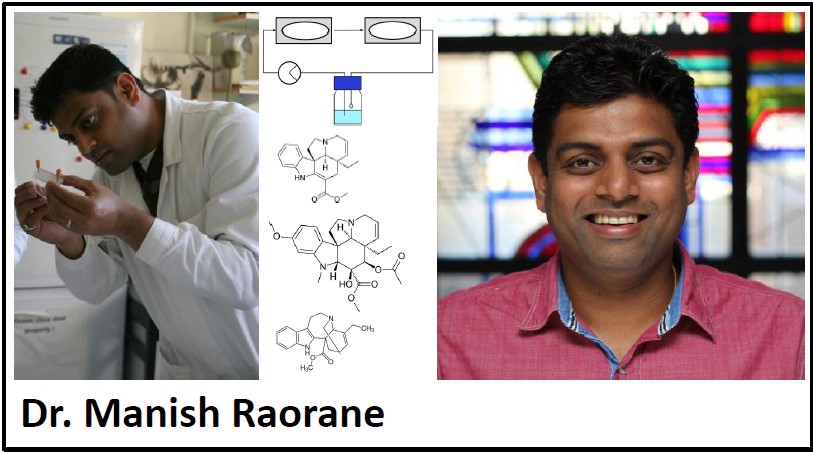 |
Dr. Manish RaoraneIn the lab: from 2016-2018 Currently: Postdoc in the Department Biosynthesis of Active Compounds (group Prof. Dr. Björn Junker), Martin-Luther University, Halle. more... Activities in our lab: Manish was joining our lab coming from the International Rice Research Institute (IRRI), where he worked with Dr. Ajay Kohli on metabolomics in rice. He was taking the lead in our BMBF project on the microfluidic biofermenter together with the Institute of Microsystems Technology and Phyton, the world-leading company in the field of Plant Cell Fermentation. Manish was bringing our HPLC into good shape and supervised a PhD student, Christine Manz, in two projects on cell cultures from Taxus chinensis (generating the relevant anti-cancer compound Paclitaxel) and the Madagassian Periwinkle (Catharanthus roseus), a medicinal plant generating the precious Vinca alkaloids. Using a combination of precursor feeding and combinatorial cultivation using the microfluidic biofermenter, he was able to tickle out the crucial precursor vindoline that had been hunted for in cell cultures over decades in vain. After the project, he moved to Halle, where is working on metabolic flux analysis in Mint and now, in a collaboration with us, tobacco BY-2 cells. |