
2024_02: Root Chip for Bioherbicides
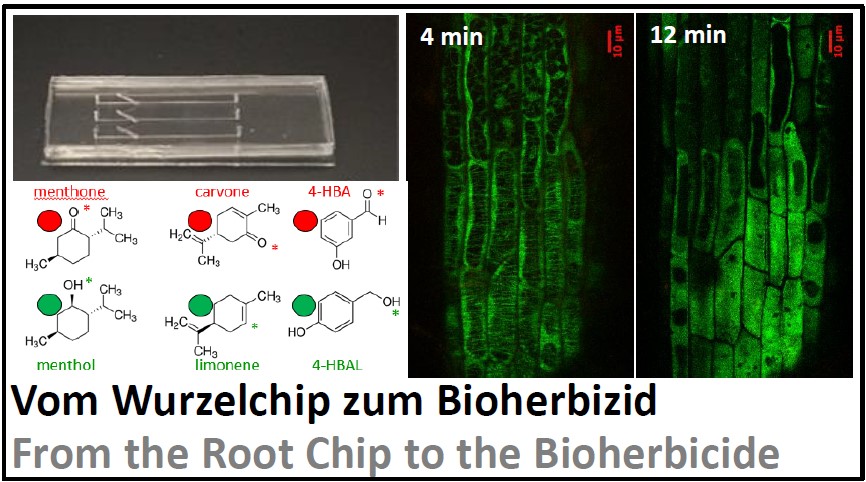 |
Plants have sly old ears. An estimated million compounds occur only in plants and have the task to convince other life forms to do work for plants. Often, cellular signalling is hijacked. We humans are no exception – whether it is caffeine, opium, or Cannabis, specific plant compounds play tricks to our neural system. One particular weird case of plant manipulation could now be uncovered. Our Mints beat competitors by a „Deathly After Eight“. Why does this not damage the sender himself – here the compounds are most abundant? Using Spearmint as paradigm, we could demonstrate that the scent, carvone, persuades root cells of the target to dissolve its microtubules and initiate a ritual form of suicide. Changing minute details on fhte molecule eliminates this effect. Thus, carvone is not a poison, but a persuasive signal. Obviously, this signal can bind to a specific receptor that otherwise has the task to ward off microbial attacks. In that context, cellular suicide makes perfectly sense. By its sacrifice, the infected cell kills the intruder and protects the others. We suspect that Mints have modified their own receptor, such that carvone cannot bind. Signals that eliminate competitors – this has, of course, considerable potential for the development of novel bioherbicides. In the next step we want to find out, who listens to the signal and identify the receptor. Schritt wollen wir nun herausfinden, wer auf dieses Signal hört. This sophisticated strategy could be uncovered by our project DialogProTec (Science Offensive of Interreg Upper Rhine) during an interdisciplinary cooperation with partners at the Campus North IMT, Université de Strasbourg, the Institute for Biological Agents in Kaiserslautern, the University of Freiburg, and the Research Institute for biological Agriculture in Frick and publish in the Journal of Experimental Botany. Publication 210. Hering N, Schmit AC, Herzog E, Corbin LT, Schmidt-Speicher L, Ahrens R, Fauconnier ML, Nick P (2024) Spearmint Targets Microtubules by (−)-Carvone. Hort Res 11, uhae151 - pdf
|