
  |
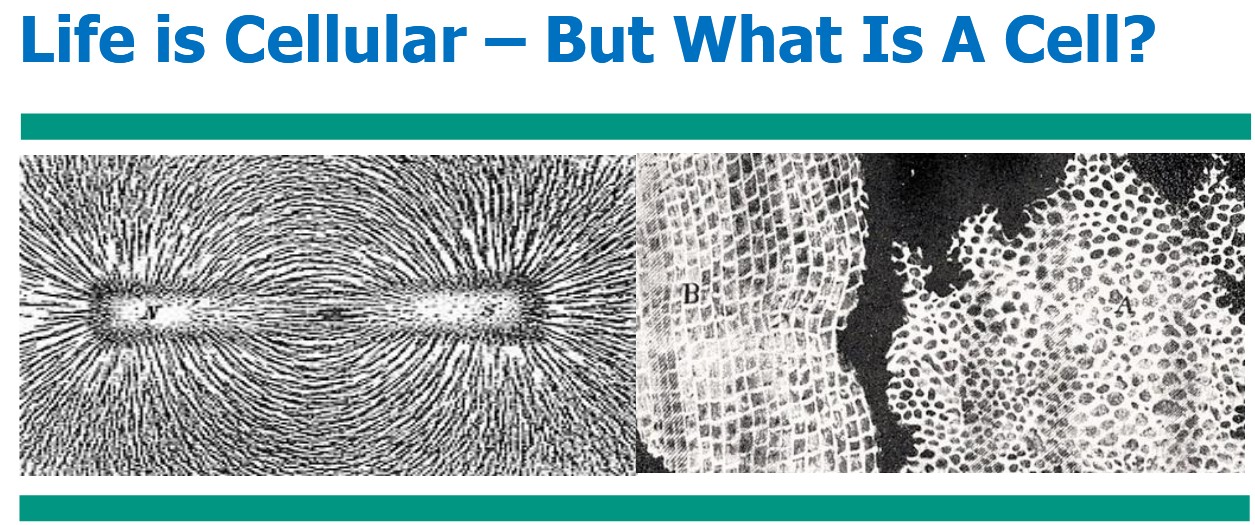
WS 2025-2026: Life is Cellular – But What Is A Cell?Discovered by Robert Hooke in a piece of cork, cells were only two centuries later recognised as building block of Life. Meanwhile, "cells" have turned into a central concept of biology. Like other central concepts of biology, they have remained strangely elusive, though. The textbook image of a box, where neatly separated organelles generate "Life", is definitely wrong. But how do we have to conceptualise "cells"? We approach this question from different directions - How to imagine the genesis of the first cell? How to get from there to the far more complex eukaryotic cell? How to understand that cells occur in different types? Can we engineer "cells" from the scratch? How do cells of different life forms relate to each other, when they cooperate in complex ecosystems?
Time: Tue 14:00-15:30
|
||
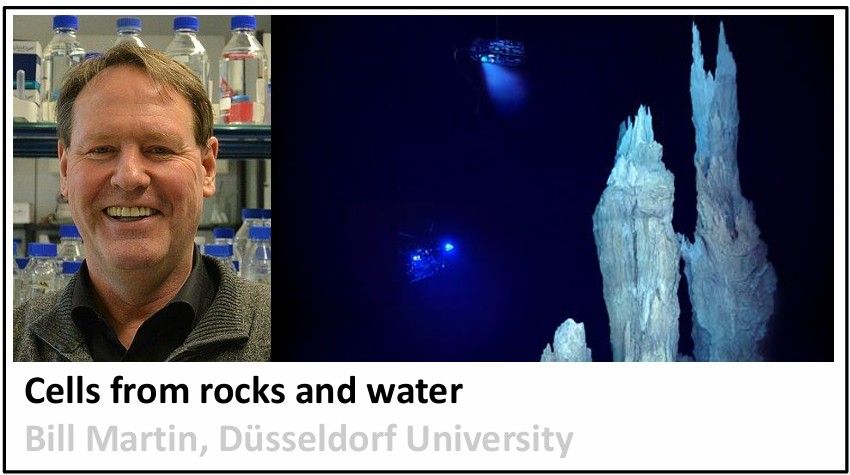 |
Cells from rocks and waterIm Rahmen des Forums für Kritische Interdisziplinarität (mehr...) geht es dieses Semester um ein zentrales Konzept der Biologie - die Zelle. Leben ohne Zellen gibt es nicht, aber wie ist die erste Zelle entstanden? Prof. Dr. Bill Martin, Heinrich-Heine Universität Düsseldorf: Cells from rocks and water. Di, 25. November 2025, 14:00. Gbd. 40.50 Engler-Bunte HS
Biology is a science of exceptions, which makes it all the more significant when we find biological rules to which there are no exceptions. The principle of the cell is one such rule. All life is composed of cells. There are no exceptions. Virusses are not an exception, as they are not life, they are parasites that always require a living, metabolizing cell for their own proliferation. What are cells? From the standpoint of life as a process, cells are sets of exergonic aqueous chemical reactions (metabolism) that fuel endergonic catalyst-formation reactions (instructed peptide synthesis) surrounded by a lipid membrane that separates the latter two from the environment. How can something of such complex nature have arisen from the elements on the early Earth? Life and cells obey the laws of thermodynamics. That makes it easy to order things. Because metabolism makes everything in the life process go forward, it had to come first. Information makes metabolism heritable, it requires metabolism (energy) and compartmentation but not lipids. It came second. Lipids are only required for the free living state. They came last, and they differ across the Bacterial-Archaeal divide. That leaves us looking for geochemical environments that fix carbon dioxide and release energy (precursors of metabolism), harbour good inorganic catalysts (precursors of enzymes), and naturally form inorganic compartments (precursors of cellular organization) that contained proto-life until cells could emerge. Hydrothermal vents provide all three components: organic energy, catalysts and compartments. Did life arise there? Almost certainly. How? That is the subject of the talk. Literature: https://arxiv.org/abs/2510.08410 or www.molevol.hhu.de |
||
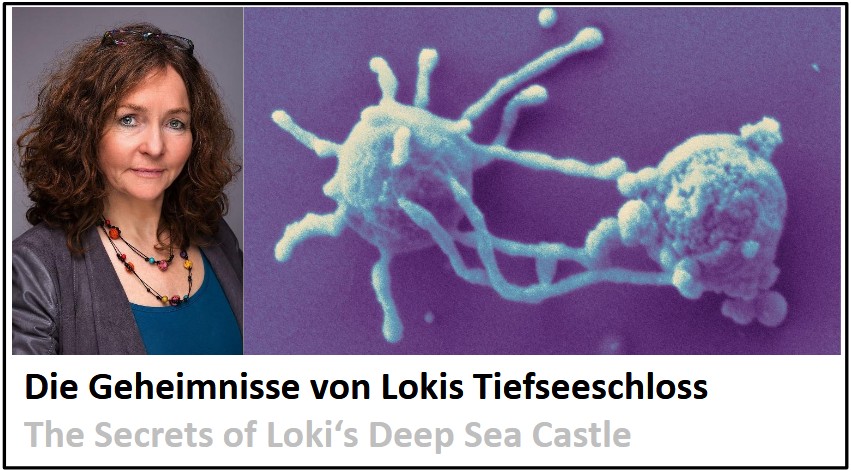 |
The Secrets of Loki's Deep Sea CastleIn frame of the Forum for Critical Interdisciplinarity (more...) we address this semester a central concept of biology - the cell. There is no Life without cells, but what is a cell?
Prof. Dr. Christa Schleper, Universität Wien: Asgard Archaea: the cradle of complex cells.
Di, 09. Dezember 2025, 14:00. Gbd. 40.50 Engler-Bunte HS
The first life forms are thought to have arisen in the deep sea, probably in so-called white smokers, hot springs, where, due to geochemical events, tiny cells from pyrit, but also metallic surfaces, were formed. Microbes without a nucleus conquered our planet later and have remained extremely successful. At one point, however, the modern cells with their uncomparably higher complexity must have been derived. Also we belong to this group of so-called eukaryotes. How this transition might have looked like, had been a mystery for a long time. Only a few years ago, in the depth of the sea between Iceland and Spitzbergen, in a black smoker called Loki's Castle, DNA of such transitional forms had been discovered. In addition to genes typical for anuclear organisms, there were also genes, so far known only from eukaryotes. The organism itself had not been seen by anyone, though. In the meantime it became possible to cultivate a representative of this group, Lokiarchaeum ossiferum, in the laboratory. This makes it possible, for the first time, to investigate the cellular innovations that enabled complex cells.
|
||
 |
Dominik NiopekForum für Kritische Interdisziplinarität (FKI). Dominik Niopek, Universität Heidelberg, Di, 10. Februar 2026, 14-15:30. Seminarraum beim Forum (Gbd. 30.95, 1. Stock): Engineering Cells. If engineers want to understand, how a machine works, they disassemble it and then try to put it together again. Views and terminology from engineering have penetrated into modern biology – for instance, we tend to speak about “molecular mechanisms”, when we want to say that we explain, how a biological phenomenon occurs. To reassemble something as a way to understand something is a central technique in synthetic biology. However, often cellular engineering is not pursued for understanding, but simply for achieving control. Genetic engineering has not only helped to unravel the function of genes, but also resulted in technological advances that had been unthinkable before. The next level of control is to re-engineer living cells in a manner that they can be steered by signals. Dominik Niopek has been one of the leading figures in optogenetics. In the meantime, his lab is working on systems on signal-switchable allosteric control of enzymes or genome editing. |
||
Forum für Kritische Interdisziplinarität (FKI)
Was ist die Motivation?
Wissenschaft war und ist eine zentrale Triebfeder der menschlichen Kultur. Während die aktive Teilnahme an wissenschaftlichen Debatten bis weit ins 19. Jahrhundert hinein ein ganz selbstverständliches Element des Kulturlebens war, sind sich inzwischen Wissenschaft und Gesellschaft einander fremd geworden. In der gesellschaftlichen Wahrnehmung ist Wissenschaft für Außenstehende kaum zu verstehen und steht im Ruf, über "ein spezialisiertes Nichts fast alles zu wissen". Das Gespräch über die Fachgrenzen hinweg, der Mut auch von jenseits des Zauns intelligente Fragen zu stellen oder scheinbar festgefügte Ideen kritisch zu hinterfragen, ist nötiger denn je.
Was wollen wir?
Als ein Beitrag dazu richten wir im Moment am KIT das „Forum für kritische Interdisziplinarität“ (FKI) ein. Grundstock ist das Preisgeld für den Landeslehrpreis, der 2015 zum ersten Mal ans KIT ging (Presseinformation). Mit dem FKI verfolgen wir zwei Ziele:
1. Inhaltlich sollen Themen präsentiert und diskutiert werden, die interdisziplinär sind. Dies umfaßt zum einen typische Grenz- und Querschnittsfragestellungen, die zum eigenen Fragen und Diskutieren anregen, etwa „Form und Prozeß“, „Organismus und Struktur“, „Geschichte und Natur“, „Kraft und Gesetz“. Zum anderen soll aber auch die Veränderung der Wissenschaften selber – und hier vor allem die Naturwissenschaften – sichtbar gemacht werden. Wie hängen unsere Konzepte von unseren Werkzeugen und Medien ab? Wie bestimmen die Methoden, die uns zur Verfügung stehen, die Bilder, mit denen wir die Welt um uns erklären?
2. Interdisziplinarität lebt vom Gespräch und die zentrale Form des FKI wird daher das wissenschaftliche Gespräch. Ein besonderes Anliegen ist es uns daher, diese Formen zu leben und in verschiedenen Formaten für Studierende unterschiedlicher Disziplinen zugänglich zu machen. Hierher gehören neben „klassischen“ Vorträgen vor allem Themenworkshops und Summerschools.
Das FKI richtet sich an Studierenden aller Fachrichtungen, die schon Studienerfahrungen gesammelt oder einen Studienabschluß erworben haben. Wenn Sie Interesse haben, sprechen Sie uns doch einfach an!
Prof. Dr. Mathias Gutmann, Institut für Philosophie
Prof. Dr. Peter Nick, Botanisches Institut